
Mountains & Caves of Kanchanaburi: The Hiker’s Guide to Thailand’s Wild Western Frontier
5 unforgettable peaks and caves, when to visit, and how to plan it all from a riverside basecamp on the Kwai
Kanchanaburi is best known for its river — but its real magic is in the high country and the limestone underworld. Within a few hours’ drive of the Kwai Noi, Thailand’s wild western frontier hides the province’s highest peak, a knife-edge ridge with views into Myanmar, a Burmese-Siamese battlefield turned national park, and one of the longest river caves in Southeast Asia. Each opens for only a short season. Each rewards the journey with a view, a vista, or a vault of stone you’ll remember for life.
If you’re planning a hike-and-cave itinerary in Kanchanaburi, this is your map of the five destinations every adventurer should know — and how to make a riverside resort like River Kwai Resotel in Saiyok your strategic basecamp.
What you’ll find in this guide
- Khao San Nok Wua — Kanchanaburi’s highest peak (1,767 m)
- Khao Chang Phueak — The Knife-Edge Ridge of Pilok
- Khao Kamphaeng — The hidden summit of Chaloem Rattanakosin
- Tham Nok Nang Aen — The cathedral cave of Lam Khlong Ngu
- Tham Sao Hin — Home to one of the world’s tallest stalagmites
- Booking, season chart, packing list & FAQs
1. Khao San Nok Wua — The Roof of Kanchanaburi
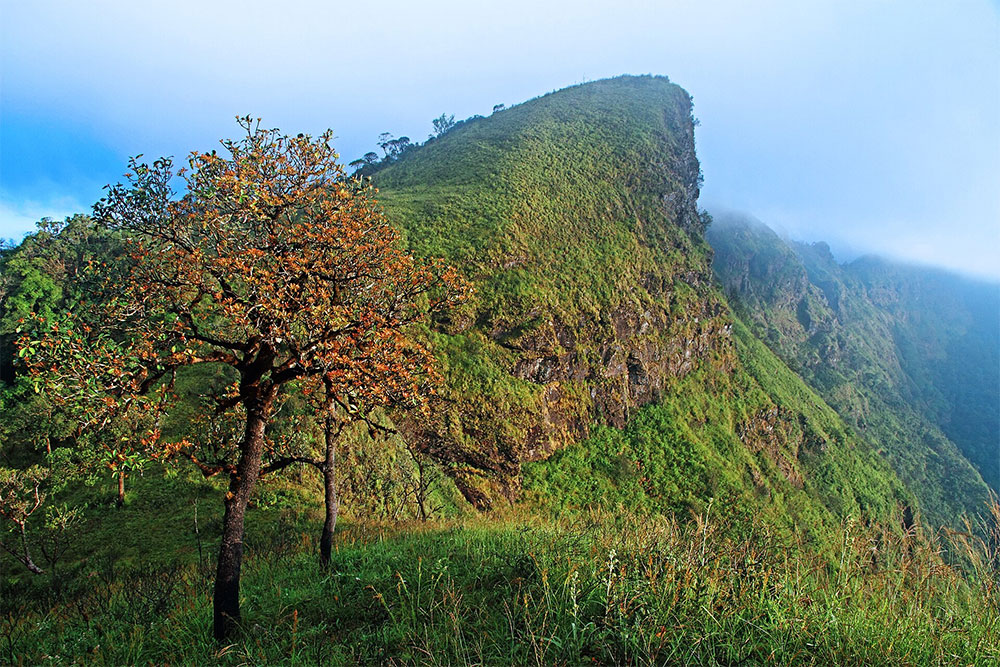
Khao Laem National Park · Sangkhla Buri · Best season: October to February
| Elevation | 1,767 metres — the highest peak in Kanchanaburi Province |
| Trail length | ≈ 9 km one way (18 km round trip) |
| Difficulty | Level 3 — challenging; steep sections with ropes |
| Open season | Early October through mid-February (annual) |
| Daily quota | Limited; advance reservation required |
| Booking | Khao Laem National Park: +66 34 510 431 (09:00–16:00) |
Why hikers come
San Nok Wua means “cow’s hump” — and from the summit you’ll see why. The grass-covered ridge bulges above a 360-degree ocean of mountains, with Vajiralongkorn Dam shimmering far below and a near-guaranteed sea of mist at sunrise. It is the highest point in Kanchanaburi and, for many Thai hikers, a once-in-a-lifetime trail.
The 9-kilometre route climbs through four distinct forest zones — tropical rainforest, mixed deciduous, hill evergreen, and high-altitude savanna — before opening onto Little Cow’s Hump and Big Cow’s Hump, the two famous viewpoints. Expect rope sections, steep pitches near 80 degrees in places, and a 2-day, 1-night camping format.
How to plan it
- Reserve early. Bookings open in phases each season; the daily cap is small and slots vanish within minutes. Book by phone via Khao Laem National Park.
- Train your legs. Most hikers take 6–10 hours up. Knees and ankles take a beating on the descent.
- Sleep close the night before. Registration is at Pom Pee viewpoint between 08:00 and 09:30. Driving from Bangkok the same morning is the most common reason hikers lose their slot.
Where to stay before and after
Sangkhla Buri is roughly 2.5 hours north of Saiyok. Many adventurers spend their final pre-hike night on the river at River Kwai Resotel — recovering, packing, and starting fresh in the cool dawn — then return the same way to soothe sore legs by the pool and the Kwai.
2. Khao Chang Phueak — The Knife-Edge Ridge
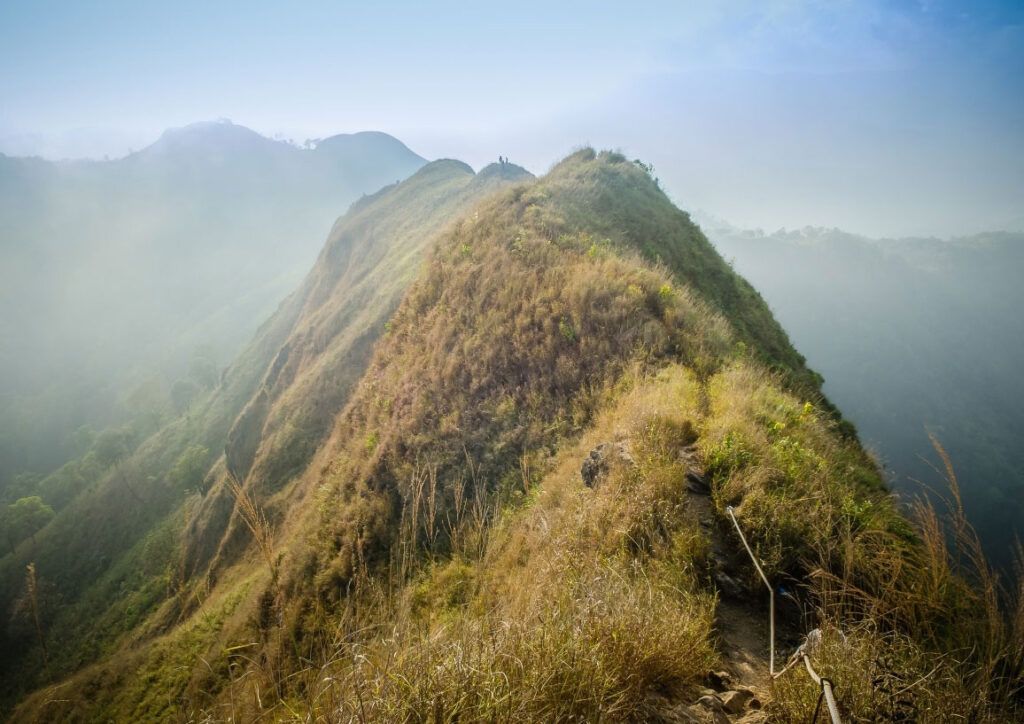
Thong Pha Phum National Park · E-Tong Village · Best season: November to January
| Elevation | 1,249 metres — third-highest mountain in Kanchanaburi |
| Trail length | ≈ 8 km one way |
| Difficulty | Hard — features the famous “San Khom Mit” knife-edge ridge |
| Open season | Roughly November to January (short window each year) |
| Daily quota | 60 hikers per day — books out fast |
| Booking | Thong Pha Phum National Park: +66 34 510 979 |
Why hikers come
Khao Chang Phueak — the “White Elephant Mountain” — is the king of Thai bucket-list hikes. The final ascent crosses San Khom Mit, the “Knife’s Edge”: a needle-thin ridge with sheer drops on both sides and 360-degree views over the Thai–Myanmar border. Sunrise here is a religious experience.
The trail begins at E-Tong, a hillside village reached via the legendary “399 Curves” road. Most groups hike in 8 km to a base camp on Day 1, climb the Knife’s Edge for sunset, and descend on Day 2 before the afternoon heat.
How to book Khao Chang Phueak
- Call the park directly. Reservations open up to 7–15 days before each trekking date. Only 60 spots release per day.
- Confirm the season. The mountain is closed most of the year for safety and wildlife — including wild elephants.
- Hire a porter. E-Tong porters can carry tents, sleeping bags and water so you can focus on the climb.
From the River Kwai to E-Tong
E-Tong is about 2 hours north of Saiyok by car. River Kwai Resotel sits roughly halfway between Bangkok and the trailhead, making it a natural pre-hike basecamp — particularly because the registration time on Day 1 leaves little margin for a same-day drive from the city.
3. Khao Kamphaeng — The Forgotten Summit
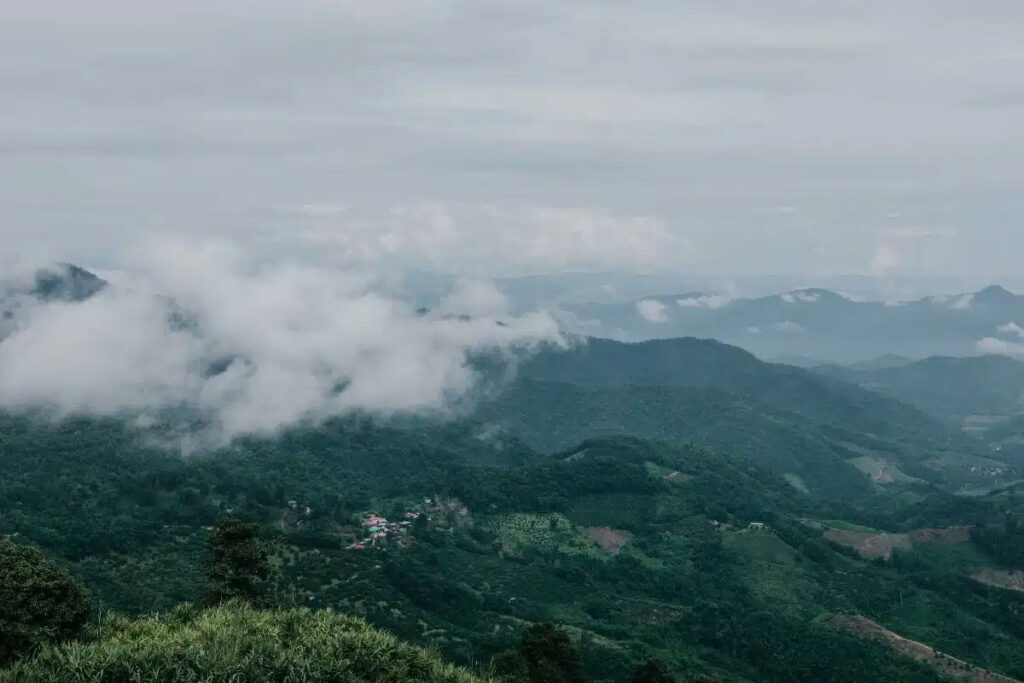
Chaloem Rattanakosin National Park · Si Sawat · Best season: October to January
| Elevation | ≈ 1,260 metres — highest peak of Chaloem Rattanakosin |
| Trail length | ≈ 6 km one way |
| Difficulty | Hard — relentlessly steep, very little flat ground |
| Open season | Roughly October through January / February |
| Famous for | “Khao Boran” — ancient stacked-stone formations like a wall |
| Booking | Chaloem Rattanakosin National Park; advance reservation required |
Why hikers come
If San Nok Wua is famous and Chang Phueak is iconic, Khao Kamphaeng is the connoisseur’s hike — the highest peak inside Thailand’s smallest national park. The trail climbs through bamboo forest into a strange, almost archaeological section called “Khao Boran” (Ancient Mountain), where stacked stones resemble the ruins of a defensive wall — hence the name Kamphaeng, “wall”. Old pottery shards hint at long-vanished settlements.
The summit reward is a quiet panorama over the Krap Roi Reservoir, with morning mist that lingers in the valleys long after sunrise. Crowds are far thinner than on the famous peaks.
Logistics
- Trail is steep but short — fit hikers can summit in 4–6 hours one way.
- Guides are mandatory; the park assigns them on booking.
- Combine with a visit to Tham Than Lot — a natural limestone tunnel inside the same park, formed by the collapse of a cave ceiling.
4. Tham Nok Nang Aen — The Cathedral of Light
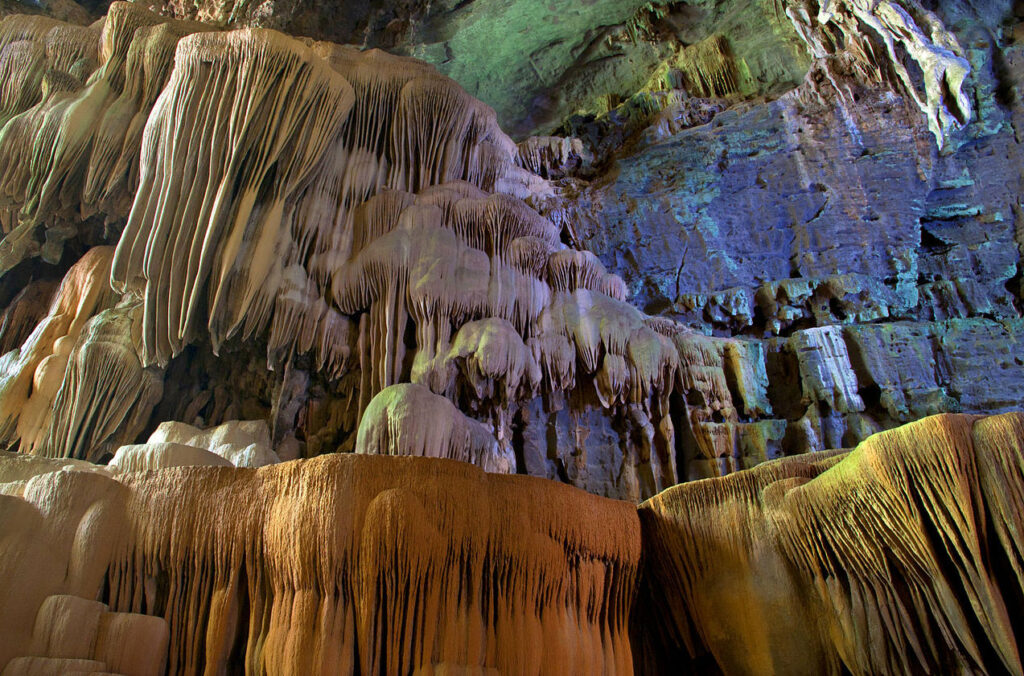
Lam Khlong Ngu National Park · Thong Pha Phum · Best season: March to April
| Cave length | ≈ 3 km — a river-traversed cavern with 6 karst windows |
| Highlight | Sunbeams pouring through collapsed ceilings onto underground river |
| Difficulty | Adventurous — wading, swimming, and a 5–6 m water jump |
| Open season | Roughly March to early May (when water levels are safe) |
| Requirements | Age 15–60, healthy, able to swim |
| Booking | Lam Khlong Ngu National Park: +66 84 913 2381 |
Why explorers come
Tham Nok Nang Aen — “Swallow Cave” — is what happens when a mountain river decides to live underground. The Khlong Ngu River flows straight through three vast chambers, each lit by a karst window — a section of cave ceiling that collapsed long ago, allowing daylight to flood in. Stand inside, look up, and you’ll see jungle vines and sky framed in stone.
The visit is half-day, guided, and limited in numbers. Expect to wade, swim short stretches, and — if you choose — take a 5–6 metre leap from a ledge into the river below. The cave is named for the thousands of swallows that nest in its dark recesses.
5. Tham Sao Hin — One of the World’s Tallest Stalagmites
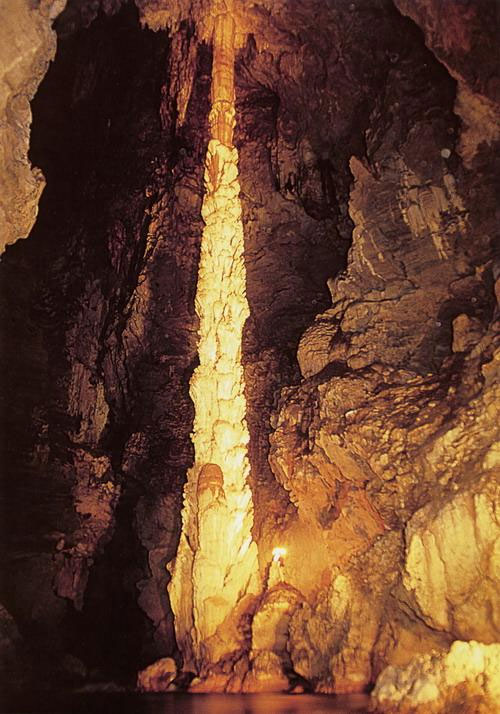
Lam Khlong Ngu National Park · Thong Pha Phum · Best season: March to April
| Famous for | A limestone column over 62 metres tall — among the world’s tallest |
| Trail to cave | ≈ 4 km approach trek through tropical forest |
| Difficulty | Strenuous — full-day expedition; guide and gear required |
| Open season | Roughly March to early May, paired with Nok Nang Aen |
| Booking | Same park office as Nok Nang Aen |
Why this cave matters
Tham Sao Hin — “Stone Pillar Cave” — is the sister cave to Nok Nang Aen and the more demanding of the two. Where Nok Nang Aen is bathed in sunlight, Sao Hin is pure black: a chamber so vast that even powerful torches lose themselves in the dark. At the centre rises a single limestone column estimated at over 62 metres in height — taller than a 20-storey building, and ranked among the tallest stalagmites on Earth.
This is a full-day expedition with restricted access, capped numbers, and a strict short season. For serious cavers, it’s the prize of Kanchanaburi.
When to Hike What: Kanchanaburi’s Adventure Calendar
Every one of these destinations has a strict opening season, set by the National Parks to protect wildlife and ensure visitor safety. Plan your trip around the calendar, not the other way round.
| Destination | Best Months | Type | Approx. Distance from Saiyok |
| Khao San Nok Wua | Oct – Feb | Mountain | ~ 2.5 hrs north |
| Khao Chang Phueak | Nov – Jan | Mountain | ~ 2 hrs north-west |
| Khao Kamphaeng | Oct – Jan | Mountain | ~ 3 hrs north-east |
| Tham Nok Nang Aen | Mar – Apr | Cave | ~ 2 hrs north |
| Tham Sao Hin | Mar – Apr | Cave | ~ 2 hrs north |
What to Pack for a Kanchanaburi Mountain or Cave Trip
- Sturdy trail shoes with grip — many sections are steep limestone or scree
- Long, breathable pants — protection from grass cuts and leeches
- Headlamp + spare batteries (essential for caves, useful for pre-dawn ridge starts)
- 2–3 litres of water per day, plus electrolyte sachets
- Light fleece or windbreaker — summit nights can drop to 10–15°C
- Quick-dry clothes and a dry bag for cave visits (you will get wet)
- Sunscreen, hat, insect repellent
- Photocopy of your Thai ID or passport for park registration
Where to Stay: Why a Riverside Basecamp Changes Everything
All five of these destinations share one quirk: their registration times are early, their roads are long, and their seasons are short. The smartest itinerary doesn’t start on the mountain — it starts the night before, on the river.
River Kwai Resotel in Saiyok sits on the Kwai Noi, roughly two hours upriver from Kanchanaburi town and within striking distance of Thong Pha Phum, Sangkhla Buri, and Si Sawat. Guests typically arrive a day early, sleep deeply to the sound of the river, and leave for the trailhead before sunrise — returning the next evening to a hot shower, a cold drink at the Club House Bar, and dinner overlooking the water.
It is also a destination in its own right. Within 100 metres of the resort is Lawa Cave — Saiyok National Park’s largest cavern, with chamber after chamber of stalactites — making it a perfect warm-up before the more demanding caves at Lam Khlong Ngu.
Why guests choose River Kwai Resotel as their hiking basecamp
- Located on the Kwai Noi inside Saiyok, the gateway to upper Kanchanaburi’s mountains
- Boat-access arrival from Phutakien Pier — a 7-minute jungle cruise into the resort
- 100 metres from Lawa Cave for a gentle pre-trip caving session
- Quiet, jungle-set chalets to recover legs after long descents
- Spa and Thai herbal massage for post-hike recovery
- Riverside restaurant and pool — open until late for hikers returning at dusk
Frequently Asked Questions
Optimised for Google’s featured snippets and AI answer engines. Format as schema FAQPage on publish.
What is the best month for hiking in Kanchanaburi?
November to January is the prime hiking season in Kanchanaburi. Temperatures are coolest, humidity is lowest, and the famous peaks of Khao San Nok Wua and Khao Chang Phueak are open. For caves like Tham Nok Nang Aen and Tham Sao Hin, the best window is March to April, when water levels inside Lam Khlong Ngu are safe.
What is the highest mountain in Kanchanaburi?
Khao San Nok Wua in Khao Laem National Park is the highest peak in Kanchanaburi Province, at 1,767 metres above sea level. The summit offers a 360-degree view over the Tenasserim mountain range and Vajiralongkorn Dam, and is famous for its sea of mist at dawn.
Do I need to book Kanchanaburi national park hikes in advance?
Yes. All five destinations in this guide enforce daily visitor caps and require advance booking through the national park office. Khao Chang Phueak limits visitors to 60 per day; Tham Nok Nang Aen and Tham Sao Hin allow only small guided groups during a 1–2 month annual window. Reserve as early as possible.
Is Khao Chang Phueak’s Knife-Edge Ridge dangerous?
The Knife-Edge Ridge (San Khom Mit) is a narrow rocky spine with sheer drops on both sides. It is not technically a climb — but it requires steady balance, calm in exposure, and a head for heights. Park rangers escort all visitors across the ridge, and the route is closed in poor weather.
How far is River Kwai Resotel from these hiking trailheads?
River Kwai Resotel is in Saiyok, roughly halfway between Bangkok and the upper Kanchanaburi mountains. Driving times from the resort: about 2 hours to Khao Chang Phueak (E-Tong), 2 hours to Tham Nok Nang Aen and Tham Sao Hin, 2.5 hours to Khao San Nok Wua (Sangkhla Buri), and 3 hours to Khao Kamphaeng (Si Sawat).
Can beginners hike in Kanchanaburi?
Yes — but match the trail to your fitness level. The five destinations above are all moderate to hard. Beginners should start with Lawa Cave (next to River Kwai Resotel), the Tham Than Lot tunnel in Chaloem Rattanakosin, or the Erawan Falls trails before progressing to the named peaks.
How long should I plan for a Kanchanaburi hiking trip?
Plan a minimum of 3 days and 2 nights for any of the major peaks. Day 1: travel from Bangkok and overnight at a riverside basecamp like River Kwai Resotel. Day 2: register at the park, hike in, camp at the summit. Day 3: descend, recover, return. For caves like Tham Sao Hin, allow a full day inside the park.
Plan Your Kanchanaburi Adventure
Kanchanaburi’s mountains and caves are not casual day trips. They reward planning, fitness, and respect for a fragile wild west of Thailand. But the payoff — sunrise on a knife-edge ridge, a sunbeam in a cathedral cave, a stalagmite the height of a high-rise — is one of the great experiences of Southeast Asia.
River Kwai Resotel is here to be your quiet riverside basecamp before and after the trail. Our team can help you coordinate timing, transport, and recovery so the adventure is the part you remember most.
Book your stay or speak to our concierge: serenatahotels.com/kanchanaburi/river-kwai-resotel